South transept: Underhill window
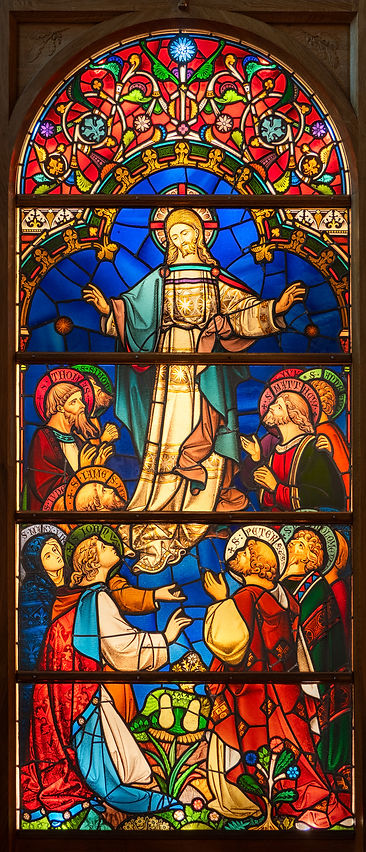
The following description of the Underhill window is by Jeremy Lawford:
This window, which is displayed in rotation in the south transept, represents the Ascension of Christ into heaven on the fortieth day after the Resurrection. It was one of a pair from the old St David’s which did not fit into Caröe’s design for the new church, so they were packed away and stored in the muniments room. The original windows each consisted of 15 panels and were 3m high and nearly 1.5m wide. In 2004 the decision was taken to reassemble the pictorial sections of the two windows, and to display them alternately, without their decorative borders and inscriptions, in a light box built for the purpose.
The window was dedicated to the memory of Thomas Underhill, who died in 1858, and of his wife Mary Ann, who died three years later. The inscription records that it was ‘erected’ by Thomas’s brother William. Thomas and William were sons of a hosiery manufacturer who carried on his business at various addresses in and around Exe Street. Thomas was a ‘frame work knitter’ and presumably worked for his father. He married Mary Ann Pope in 1847.
William, who was ten years younger than Thomas, worked as an artist for the London firm of Clayton and Bell, one of the most important and successful manufacturers of stained glass windows of the time. When the two windows were installed in 1862, the Exeter Flying Post reported that he himself “executed the chief portion of the work”. As such they have recently attracted the interest of the British Society of Master Glass Painters, being the only known examples of his work. William died in 1868 as a result of a tragic accident during the construction of the new Foreign Office building in Whitehall.
The Underhill window was featured in the “Art and Soul” exhibition of Victorian Gothic art and architecture at the Royal Albert Memorial Museum in 2015.