South wall: Hoskins window
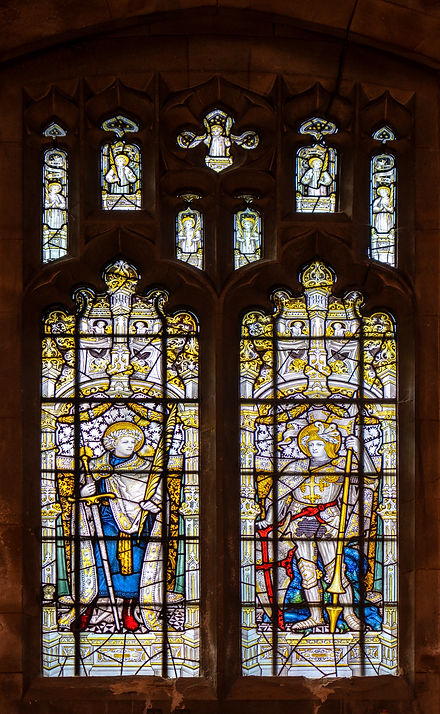
The following description of the Hoskins window is by Jeremy Lawford:
This window is the second from the right in the south aisle of St David’s. Like most of the windows in the church, it was designed by Charles Eamer Kempe, whose distinctive wheatsheaf trademark can be found towards the lower left-hand corner. The figures represent two martyred soldier saints, St George and St Alban.
The window is dedicated to the memory of Sergeant Arthur Hoskins of the 27th (Devonshire) Company of the Imperial Yeomanry, who was killed at the battle of Vlakfontein on 29 May 1901 during the Second Boer War. A hastily trained contingent of volunteers had been sent out to South Africa a short while before, and Vlakfontein was their first engagement. Arthur Hoskins had recently transferred from the 1st Rifle Volunteers in search of active service and had been promoted to sergeant before the men left Aldershot. He was 23 when he died.
Hoskins had been employed by the Inland Revenue in Trowbridge, Wiltshire, and colleagues from all over the country raised the £80 cost of the window by subscription.
The window was dedicated by the Vicar of St David’s, the Revd C J Valpy French, on Sunday 31 August 1902. A large congregation heard him preach on the text “He that loveth his life shall lose it”. The two martyrs had both fought against persecution, and in their deaths had proclaimed their belief that what people find when they answer the call of duty is worth having, even at the cost of life. This soldiers’ window would act as a reminder of this to the people of St David’s.
Arthur Hoskins was the son of William George Hoskins, master baker of 54 St David’s Hill. He was one of at least 10 children and was educated at Hele’s School. His father died in 1904, and the eldest of Arthur’s brothers, also William George, carried on the business in the same premises until his death in 1955. It was in this building, in 1908, that the third William George Hoskins was born. He went on to become the eminent historian and author of important works such as Devon and its People, Two Thousand Years in Exeter and The Making of the English Landscape.
A blue plaque marks the house (now renumbered 26-28) where Professor Hoskins was born, and where his father’s younger brother, Arthur, spent his teenage years.